How to get the most out of your travel credit card
The best travel card for you depends on how much you spend, where you spend, and whether you will actually use the credits attached to a high annual fee.

Three separate rewards from three separtate sources, all on one booking. Loyalty points stack with credit card points stack with cash back. Here's how to claim all three.
.avif)
Yes, you can earn hotel loyalty points, credit card points, and cash back on the same booking. Book direct on the hotel's own website with your loyalty number attached, pay with a rewards credit card, and use a hotel cash back extension to capture a rebate on top. All three reward layers pay out independently; the only thing that breaks the stack is booking through a third-party travel site.
Here's the situation almost every traveler is in: you book a hotel, you earn points with that hotel's loyalty program, and that's the end of it. Maybe you also get credit card points, if you thought about which card to use.
But a single hotel booking can pay you back in three separate ways at once, and they don't compete with each other. They're paid by three different parties, for three different reasons.
Understanding why they don't conflict is what makes the whole thing click.
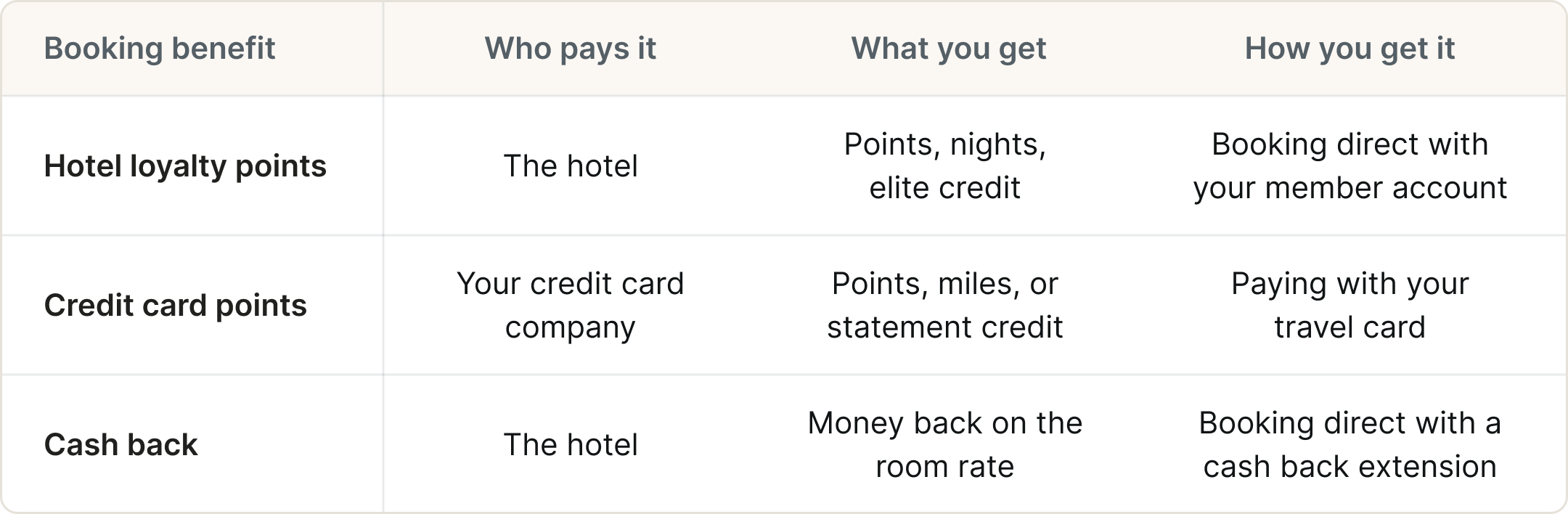
Notice that no two of these come from the same source. Marriott isn't paying for your Amex points. Amex isn't paying for your Bonvoy points. And the cash back doesn't come out of the loyalty program at all.
Where the cash back actually comes from is worth understanding, because it's the part nobody explains. A hotel pays a commission on your booking regardless of how you book it. Book through a third-party travel site and that site collects the commission and keeps it. Book direct through a cash back extension and the extension is paid the commission instead — and passes it back to you. That's the whole model, and it's why the reward exists at all.
The hotel's cost is roughly the same either way. What changes is whether that money ends up with a middleman or in your pocket.
And because the commission is a separate transaction from the loyalty program, your points are untouched. These aren't slices of the same pie. They're three different pies.
This has to happen first, because the extension needs to be active during the booking session to capture it. Installing it after you've booked doesn't retroactively earn you anything.
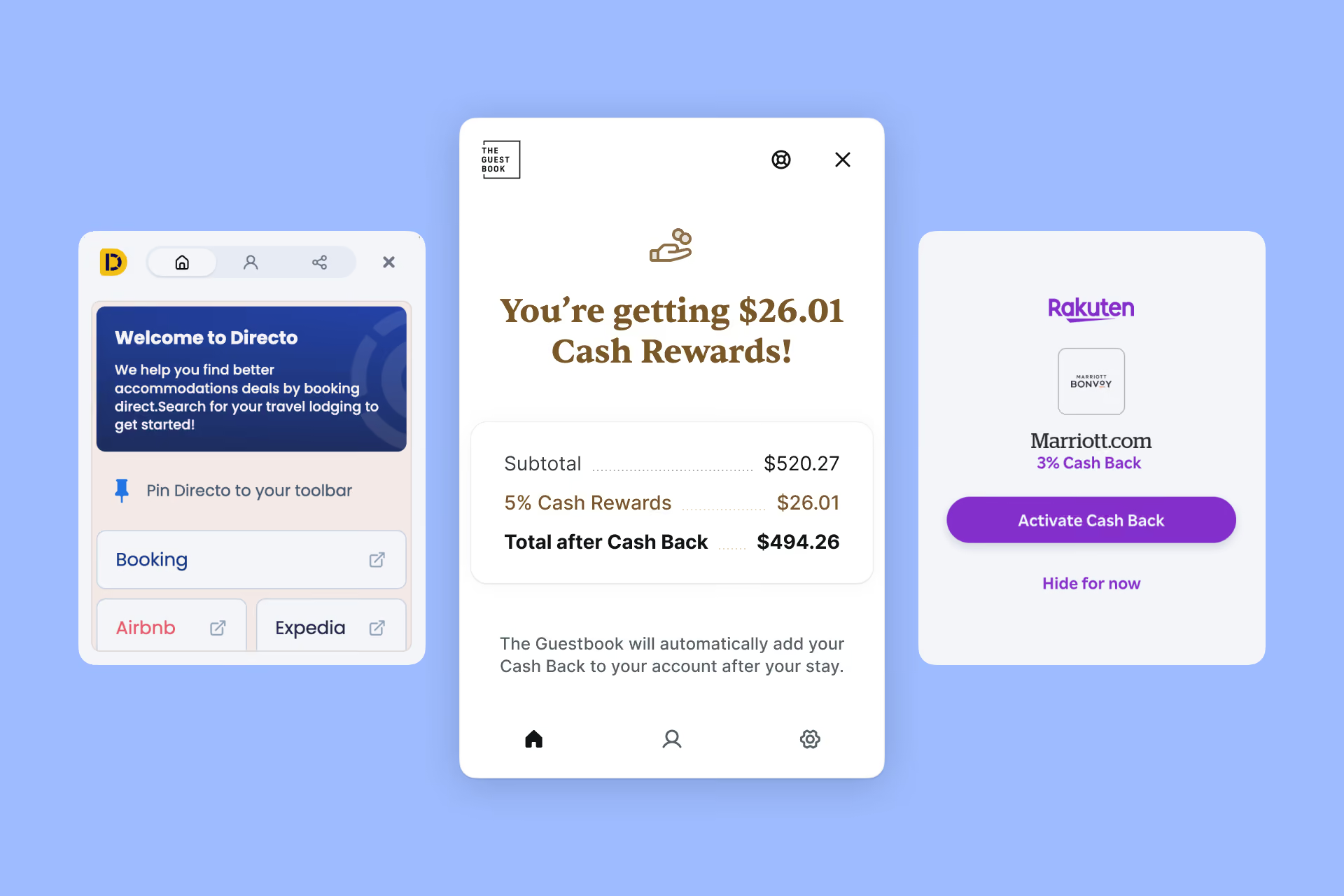
The Guestbook's extension, for example, is free and installs from the Chrome Web Store in about two minutes. Whichever you use, pin it to your toolbar so you can see when it activates.
This is the step that makes or breaks the whole stack, so it's worth being blunt about it.
You can start anywhere — Google, a comparison site, a third-party travel site. Browsing is fine. But the transaction itself has to happen on the hotel's official website. Marriott Bonvoy Hotels | Book Directly & Get Exclusive Rates . Hotels by Hilton - Book the Best Rates Across All Brands. Hyatt.com. The independent property's own booking page.
If you complete the booking inside a third-party travel site, you typically lose all three layers at once: no loyalty points, no elite night credit, and no cash back, because there's no direct booking to attach a reward to. You've handed the entire margin to the middleman.
If you're already on a third-party site when you decide, the extension will flag it and route you to the hotel's own site to finish.
Obvious, and constantly skipped. Points, night credit, and elite qualification only post if your member number is attached to the reservation at the time of booking. Sign in first, then select your rate — not the other way around.
If you're not a member of that brand's program, join before you book. It's free and it takes a minute.
Where this step applies: essentially every major chain and all of their sub-brands. Marriott Bonvoy covers Ritz-Carlton, St. Regis, Westin, Sheraton, Courtyard and the rest. Hilton Honors covers Waldorf Astoria, Conrad, DoubleTree, Hampton. World of Hyatt covers Park Hyatt, Andaz, Thompson, Hyatt Place. Same for IHG, Choice, and Best Western. If the property flies a chain flag, there's a points program to sign in to.
Where it doesn't: independent and boutique hotels. Most don't run a loyalty program at all, so there's no member number to attach and no points layer to earn.
Losing the points layer sounds like losing the stack. It usually isn't — and the reason is worth understanding, because it changes how you should think about boutique hotels generally.
A cash back reward isn't tied to a loyalty program. It's paid for the direct booking itself, which means it can exist at hotels that have no points to give. And independent hotels tend to pay more for a direct booking than chains do, because they don't have a global brand feeding them reservations. That difference flows through to the reward.
Take The Guestbook's extension as an example. Alongside the major chains, it covers 1,000+ independent and boutique hotels, and at those properties you pick the form your reward takes: 15% back as Cash Forward, credit toward a future stay, or 5% as straight cash, the same rate you'd get at a chain. So the stack at an independent isn't shorter so much as differently weighted:
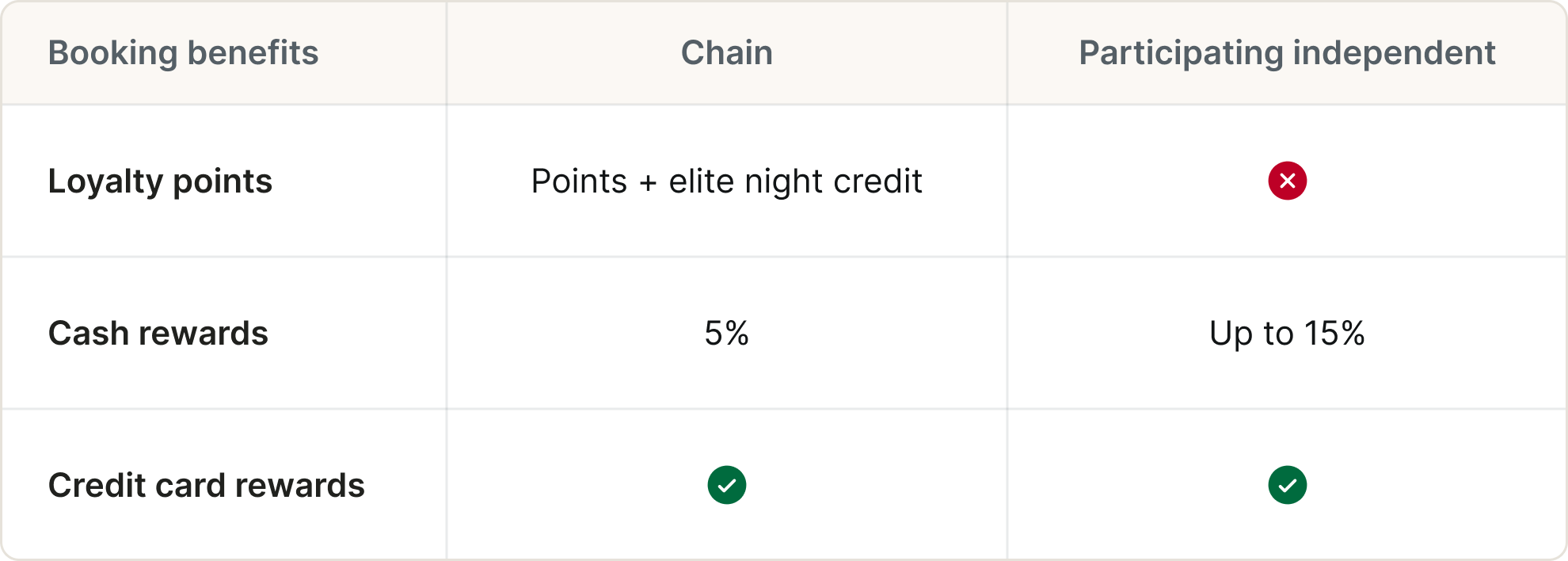
On the same $900 stay, that's a choice between $135 toward your next stay or $45 in cash.
Worth comparing both honestly against the points you'd have earned at a chain. Nine thousand hotel points come to roughly $60–70 redeemed well, and meaningfully less redeemed casually — and you can only spend them where award space actually exists. Cash Forward is a fixed dollar amount you can put against any hotel in the network, so it behaves less like points and more like a gift card that doesn't get devalued. And if you'd rather have money than travel credit, the 5% cash option is still there, which is more choice than any points program gives you.
The practical takeaway: at a chain, sign in and stack the points. At an independent, you're not earning less — you're choosing what form it comes in.
Your card doesn't care how you booked. It only cares that a charge went through. So use whichever card earns you the most on travel or hotel spend.
Two things worth checking:
When you complete the booking on the hotel's site with the extension active, the reward attaches to that reservation. You don't need a code, a receipt, or a form. Once your stay is complete, the cash back is yours.
Take a three-night stay at a major chain hotel at $300/night — $900 total.
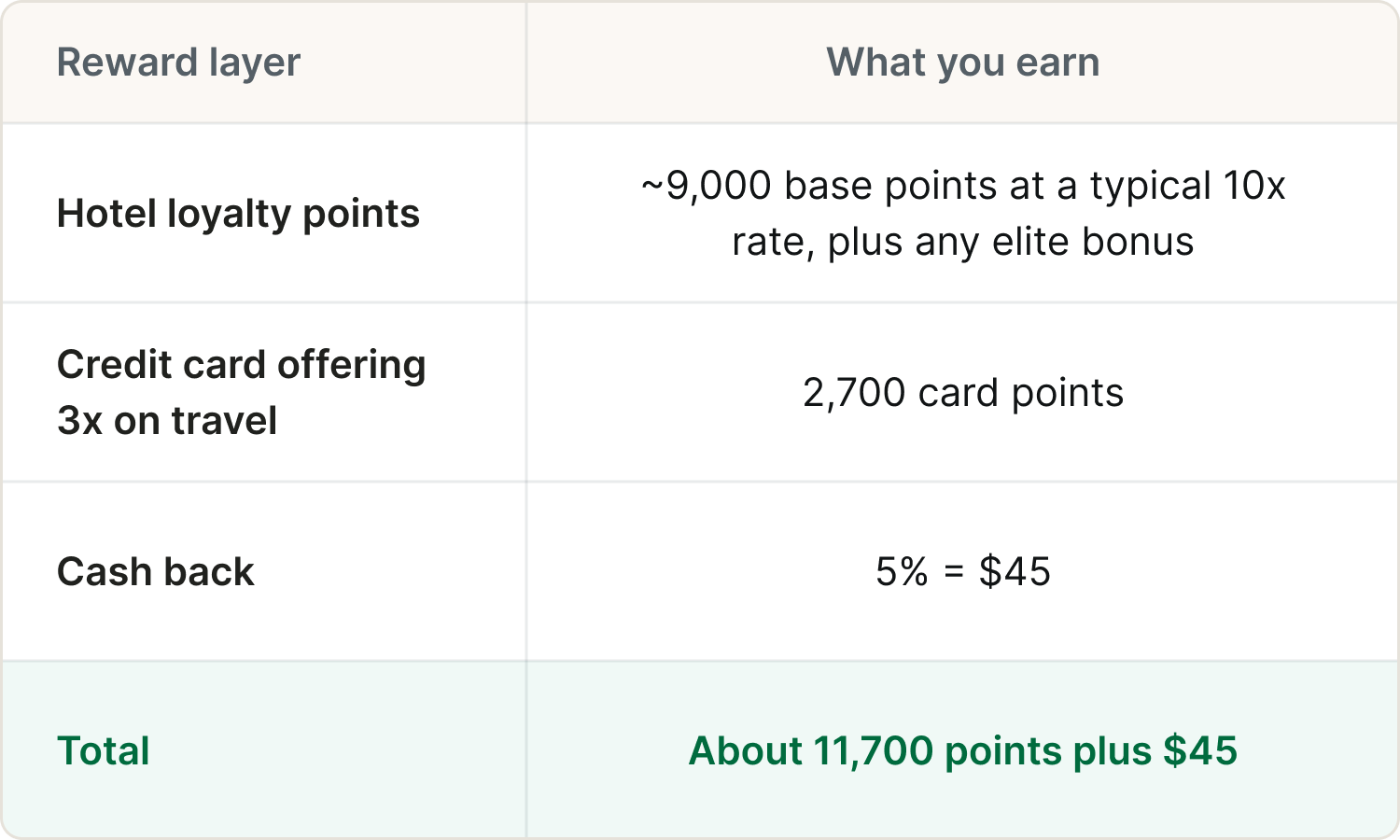
That $45 is the layer most people are not currently earning — and it's the only one of the three that's cash rather than a currency you have to redeem later at a rate someone else sets.
At a participating independent, as covered above, that layer becomes a choice: $135 in Cash Forward toward a future stay, or the same $45 in cash — in place of points you wouldn't have earned there anyway.
Points are a currency with a floating, controlled exchange rate. The program that issues them decides what they're worth, and that value has generally moved in one direction over the last decade. Award charts change. Dynamic pricing arrives. Your 9,000 points buy less than they did.
Cash doesn't have that problem. $45 is $45 in a year. It doesn't get devalued, it doesn't expire on a schedule, and it doesn't require you to find award availability at a property you actually want to stay at.
This isn't an argument against points — earn them, they're free. It's an argument for not treating points as the only thing a booking can produce. The strongest position is earning both.
Traveler behavior backs this up. In The Guestbook's 2026 survey, 72% said cash back already influences where they book hotels, and 52% said cash back would change where they book their next stay — a stronger pull than most loyalty perks.
No. Every layer of this stack is a booking made the way each program wants it made.
The hotel wants a direct booking — that's why it pays a commission to get one, and that commission is what funds your cash back. Your loyalty program wants you booking on its own site. Your card issuer wants the charge. Nobody in the chain is being circumvented, and you're not exploiting a loophole. You're just collecting all three rewards that were already on offer for the booking you were making anyway.
One booking. Three rewards. The difference between earning one layer and earning all three is about two minutes of setup and one habit: finish the booking on the hotel's own website.
Sign up for a free account to unlock exclusive hotel perks. Stay in the loop and never miss out on a great deal again.

Something went wrong. Try again later.