.avif)
How to triple dip your rewards when booking hotels online
Three separate rewards from three separtate sources, all on one booking. Loyalty points stack with credit card points stack with cash back. Here's how to claim all three.

The best travel card for you depends on how much you spend, where you spend, and whether you will actually use the credits attached to a high annual fee.
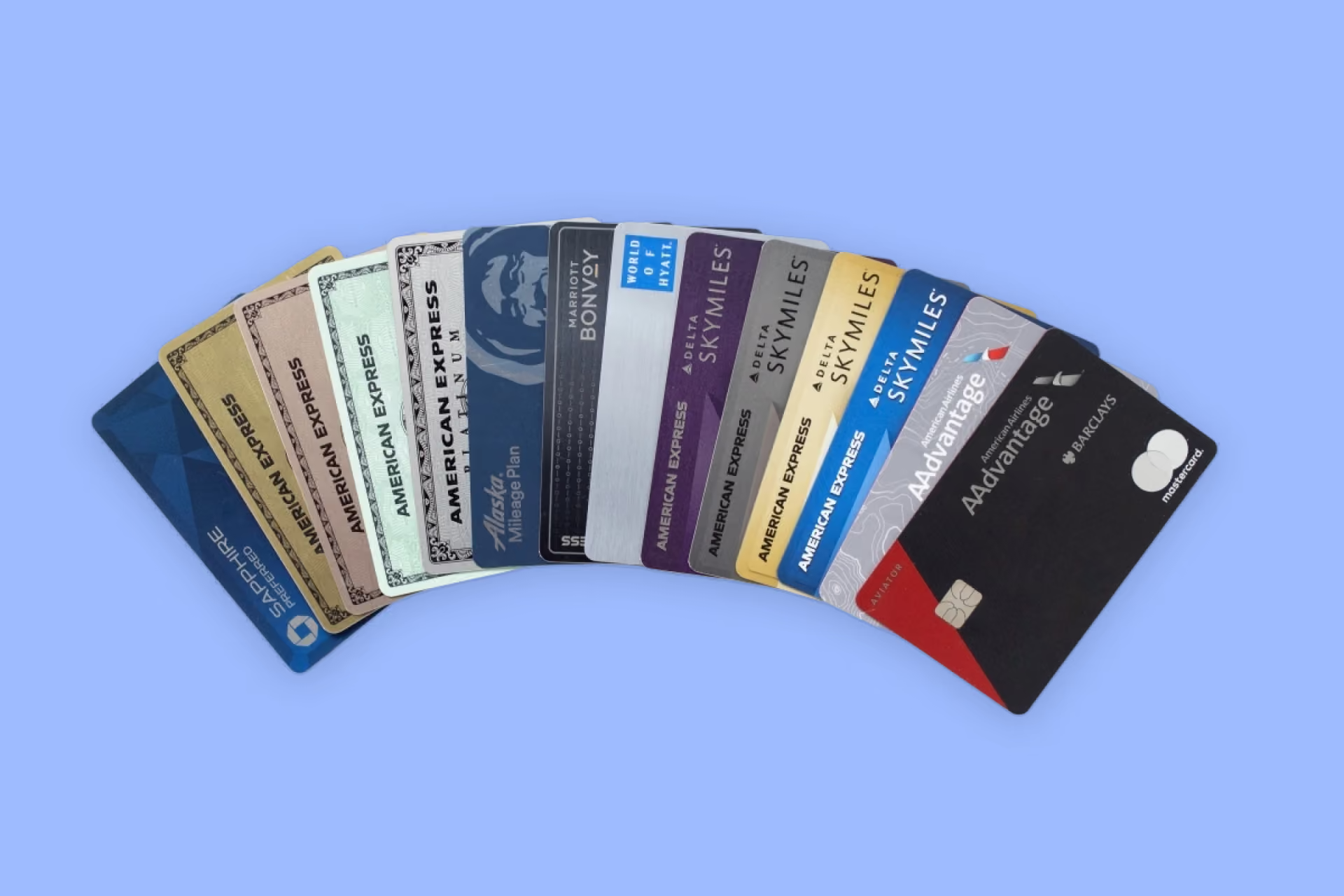
There is no single best travel credit card. The best card depends on where you spend and how you book. Flexible-points cards like the Chase Sapphire Preferred ($95) and Capital One Venture X ($395) suit most travelers; premium cards like the Chase Sapphire Reserve ($795) and Amex Platinum ($895) only pay off if their statement credits get used. Hotel co-brand cards win for brand loyalists.
Every card on every best-of list is the best card for somebody. None of them is the best card for everybody, because the math turns entirely on three things: how much a traveler spends, in which categories, and whether they will actually use the credits attached to a high annual fee.
A $795 card that returns $2,000 in credits used is a bargain. The same card held by someone who forgets to use the dining credit is a $795 donation.
So the more useful question is narrower: which card matches the way this person already travels? The comparison below is organized that way.
Fees and earn rates below are current as of August 2026. Card terms change often — several of these changed in the first half of 2026 alone — so confirm the details on the issuer's own page before applying.

Card
Annual fee
Best for
Hotel-relevant earn rate
The standout feature
Chase Sapphire Preferred
$95
A first serious travel card
5x through Chase Travel, 3x dining, 3x gas and EV charging, 2x other travel
Transferable points at a low fee. Note: the 10% anniversary bonus was discontinued for anyone applying on or after June 15, 2026
Chase Sapphire Reserve
$795 (+$195 per authorized user)
Frequent travelers who will use every credit
8x through Chase Travel, 4x on hotels and flights booked direct, 3x dining
$300 flexible travel credit, up to $500 in The Edit stay credits, $300 dining, $300 StubHub
Amex Platinum
$895
Lounge access and credit stacking
5x on flights, 5x on prepaid hotels booked through Amex Travel
Up to $600/year in hotel credits via Fine Hotels + Resorts and The Hotel Collection, $400 Resy, the widest lounge network
Amex Gold
$325
Dining- and grocery-heavy spending
4x restaurants (up to $50k/yr), 4x U.S. supermarkets (up to $25k/yr), 5x prepaid hotels via Amex Travel, 3x flights
Roughly $424/year in dining and travel credits, if the specific merchants fit
Capital One Venture X
$395
The simplest premium math
2x on everything, 10x hotels and rental cars and 5x flights through Capital One Travel
$300 travel credit plus 10,000 anniversary miles — that alone covers most of the fee
Marriott Bonvoy Boundless
$95
Marriott loyalists
6x at Marriott properties
A 35,000-point Free Night Award every anniversary, which typically outvalues the fee on one use
World of Hyatt
$95
Hyatt loyalists
Up to 9x at Hyatt
A Category 1–4 free night every anniversary, plus a second after $15,000 in spend. Hyatt points are the most valuable of the major hotel currencies
Wells Fargo Autograph
$0
Anyone unsure a fee is worth it
3x on travel, dining, gas, transit, streaming, and phone plans
Real travel earning at no cost, which makes it the honest baseline every fee card has to beat
If yes, a co-brand card is likely the highest-return option, and it isn't close. The World of Hyatt and Marriott Bonvoy Boundless cards both cost $95 and both hand back an annual free night that is usually worth more than the fee on its own. Add automatic mid-tier elite status and the elite night credits the card contributes, and the card pays for itself before any spending happens.
If no — if hotel choice is driven by price, location, or the property itself — a co-brand card is a bad fit. Its points only spend inside one brand, and its free night only works at that brand's properties.
This is where most annual-fee regret comes from. The Amex Platinum advertises well over $2,000 in credits against its $895 fee, but those credits arrive as narrow, use-it-or-lose-it slices: a semiannual hotel credit that only applies to prepaid Fine Hotels + Resorts bookings, a quarterly Resy credit, a monthly digital entertainment credit, a lululemon credit, an Equinox credit.
Each one is real money for the person who was already spending there. For everyone else, it's a coupon that expires.
A fair way to run the numbers: list only the credits you would have spent that money on anyway, ignore the rest completely, and see whether the total still clears the fee. The Venture X survives this test more easily than most premium cards, because its $300 travel credit and 10,000 anniversary miles are broad and close to automatic.
Flexible currencies — Chase Ultimate Rewards, Amex Membership Rewards, Capital One miles — can be transferred to airline and hotel partners or cashed out at a lower fixed rate. That optionality is the main argument for them.
It's also worth being honest that the exchange rate is not yours to set. In June 2026, Chase moved World of Hyatt transfers to a 4:3 ratio for new Sapphire Preferred applicants — a straight 25% cut to what had been one of the best transfer options available. Nothing stops that from happening again, to any program, at any time.
That isn't a reason to avoid points. It is a reason not to treat a points balance as savings.
Here is the part that most best-of lists skip, and it matters more than the gap between any two cards on the table above.
Premium travel cards pay their highest advertised rates for bookings made inside the issuer's own travel portal. 8x through Chase Travel. 10x on hotels through Capital One Travel. 5x on prepaid hotels through Amex Travel. Those big multiples are the numbers on the marketing page, and they're the reason a lot of people book hotels through the portal.
But a portal booking is a third-party booking. And in testing across Hilton, Hyatt, IHG, and Marriott properties, reporters at The Points Guy earned no hotel points and no elite night credits on standard hotel bookings made through the Chase travel portal. That's the general rule across issuer portals, not a quirk of one of them.
So the trade is real, and it runs in both directions:
Booking a hotel through the card's travel portal
Booking direct on the hotel's own site
Highest card multiplier (8x, 10x, 5x)
Lower card multiplier (typically 2x–4x)
No hotel loyalty points
Full hotel loyalty points
No elite night credit
Elite night credit toward status
No published rate benefits or elite treatment
Elite recognition, upgrades, late checkout
No cash back from a booking extension
Cash back available on the direct booking
One nuance worth knowing, because it's a genuine exception: Chase's curated luxury program, The Edit, does let cardholders earn both Chase points and hotel loyalty points at most participating properties. Look for the eligibility banner on the listing. Outside of programs like that one, assume a portal booking earns card points and nothing else.
The general principle holds across issuers: a high card multiplier on a portal booking is often a worse total return than a modest multiplier on a direct booking, because the direct booking earns three things at once and the portal booking earns one.
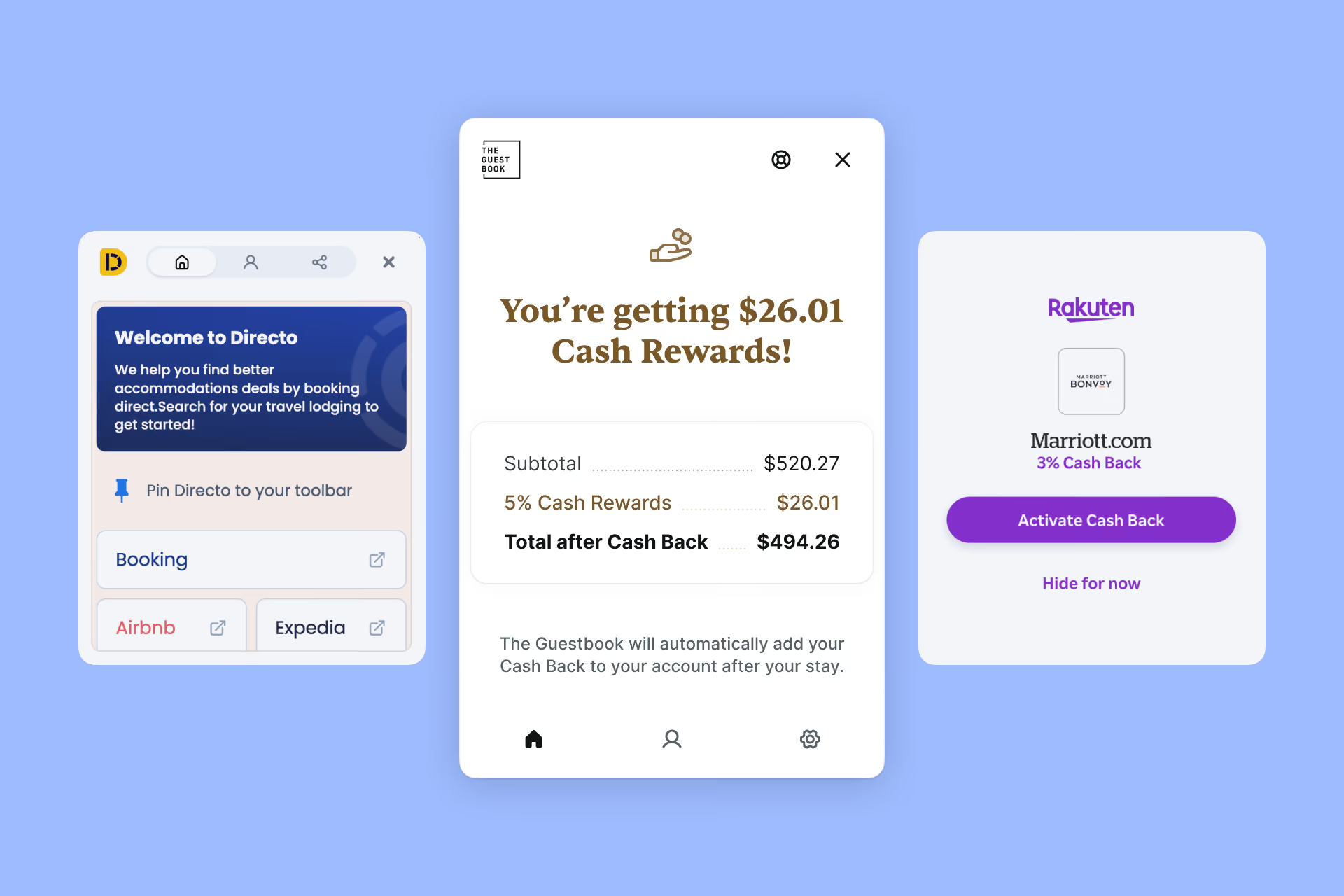
A hotel cash back browser extension is not a card, and it isn't an alternative to one. It's a third reward layer that attaches to the direct booking — the same booking that already earns hotel points and card points.
The reason that layer exists is worth stating plainly, because it's the part nobody explains. A hotel pays a commission on a booking regardless of where the booking comes from. Book through a third-party travel site and that site collects the commission and keeps it.
Take The Guestbook's extension as an example. The hotel pays The Guestbook a commission for sending it a direct booking — the same kind of commission it would pay a third-party travel site. Instead of keeping it, it passes it to you as cash back. A travel site keeps all the commission; The Guestbook doesn't.
Because that money is a commission on the booking rather than anything drawn from a loyalty program, it doesn't touch the points. Hotel points, card points, and cash back are paid by three different parties for three different reasons, and none of them reduces the others.
What it means for card strategy is straightforward: the extension raises the effective return on whichever card is already in the wallet, without a second annual fee and without changing where the booking happens. The best card is still the best card. It just earns on a booking that now pays three ways instead of two.
For the extension side specifically, it covers 60,000+ major chain hotels at 5% cash back, and 1,000+ independent and boutique hotels where the member chooses the form the reward takes: 15% back as Cash Forward, credit toward a future stay, or 5% as straight cash back.
That independent-hotel rate is the one that changes decisions. Independent properties tend to pay more for a direct booking than chains do, because they have no global brand feeding them reservations — and they also rarely run a loyalty program, so there are no points to lose by staying at one.
A three-night stay at a Marriott property at $300/night — $900 total — held by someone carrying a Chase Sapphire Reserve.
Card points
Hotel points
Elite nights
Cash back
Rough total value
Through Chase Travel (8x)
7,200
0
0
$0
$72–108
Direct on Marriott Bonvoy Hotels | Book Directly & Get Exclusive Rates (4x)
3,600
~9,000
3
$0
$96–114 + 3 nights
**Direct on Marriott Bonvoy Hotels | Book Directly & Get Exclusive Rates , with The Guestbook Extension
3,600
~9,000
3
$45
$141–159 + 3 nights
Point values are estimates, and that's the honest caveat: Chase points are worth roughly 1¢ cashed out and closer to 1.5¢ transferred well, and Marriott points run around 0.65–0.7¢. Anyone who redeems poorly should use the low end of every range.
But the ranking holds regardless of which valuation is used. The portal booking earns the biggest card multiplier and still finishes last, because it's the only one of the three that gives up two entire reward layers to get there.
At a participating independent hotel, the same $900 stay looks different again: no loyalty points to earn, but $135 in Cash Forward toward a future stay, or $45 in cash — against roughly $60 worth of chain points that can only be spent where award space exists.
The defensible version of the answer:
That last line is the one that's free. It costs no annual fee and no application, and on a $900 stay it's worth more than the difference between any two cards on this page.
Ready to add the third layer? The Guestbook's extension is free, installs in about two minutes, and works alongside any card.
What is the best travel credit card in 2026?
There is no single best travel credit card. For most travelers the Chase Sapphire Preferred ($95) offers the best balance of flexible points and low cost. Frequent travelers who will use every statement credit may do better with the Chase Sapphire Reserve ($795) or Amex Platinum ($895), and travelers loyal to one hotel brand usually earn more from a $95 co-brand card like the World of Hyatt or Marriott Bonvoy Boundless.
Is a travel credit card annual fee worth it?
Only if the credits and earn rates return more than the fee in spending you would have done anyway. Count only the credits that match your actual habits, ignore the rest, and compare the total to a $0-fee travel card. Premium cards advertise over $2,000 in value, but that value is delivered as narrow, expiring credits.
Should I book hotels through my credit card's travel portal?
Usually not. Portal bookings earn the highest card multiplier but are treated as third-party reservations, so they typically earn no hotel points, no elite night credits, and no elite recognition — and they can't earn cash back from a booking extension. Booking direct at a lower multiplier generally returns more in total.
Can you earn credit card points and hotel cash back on the same booking?
Yes. Card rewards are paid by the card issuer for the charge, and cash back is paid out of the commission the hotel pays for the direct booking. They're separate transactions from separate parties, so both pay out on the same stay, along with hotel loyalty points.
Do I need a specific credit card to use a cash back travel extension?
No. The Guestbook's extension works with any card and any hotel loyalty program. It's free to install, and the cash back is paid on the booking itself rather than on the payment method.
What is the best card for booking independent and boutique hotels?
Since most independent hotels have no loyalty program, a flexible-points card such as the Chase Sapphire Preferred or Capital One Venture X is generally the better fit than any co-brand card. This is also where a cash back extension matters most: at participating independents in The Guestbook's network, members choose between 15% back as Cash Forward toward a future stay or 5% as straight cash back — earned on stays that would otherwise produce no hotel rewards at all.
Regístrate para obtener una cuenta gratuita y acceder a ventajas exclusivas del hotel. Mantente informado y no te vuelvas a perder una gran oferta.

Algo salió mal. Vuelve a intentarlo más tarde.